Dependencies of Built APIs/WebUIs
As systems grow in scale, the connections between APIs and WebUIs become increasingly complex.
When multiple teams build multiple APIs and WebUIs that share authentication and storage infrastructure,
losing visibility into "what connects to what" becomes the greatest operational risk.
Why Tracking Dependencies Matters
Making changes without understanding dependencies can lead to unintended outages or permission leaks.
The blast radius of upgrades and rollbacks becomes unclear
When upgrading the version of a MicroService API,
every WebUI and external system connected to it may be affected.
Without dependency visibility, you don't know what to check —
leading to an "it seems to be working, so it's probably fine" approach.
This increases the risk of unexpected screen failures after a production upgrade.
Changes to the authentication layer ripple across the entire system
Changes to IAM API settings, role redesigns, or SSO switches affect every API and WebUI that depends on that IAM API.
With dependency visibility, you can identify the scope of impact before making changes and handle them safely.
Access control cannot be audited
Being unable to answer questions like "which WebUIs can connect to this MicroService API?" or "how many services use this authentication layer?" represents a security and compliance problem.
What Dependency Visualization Enables
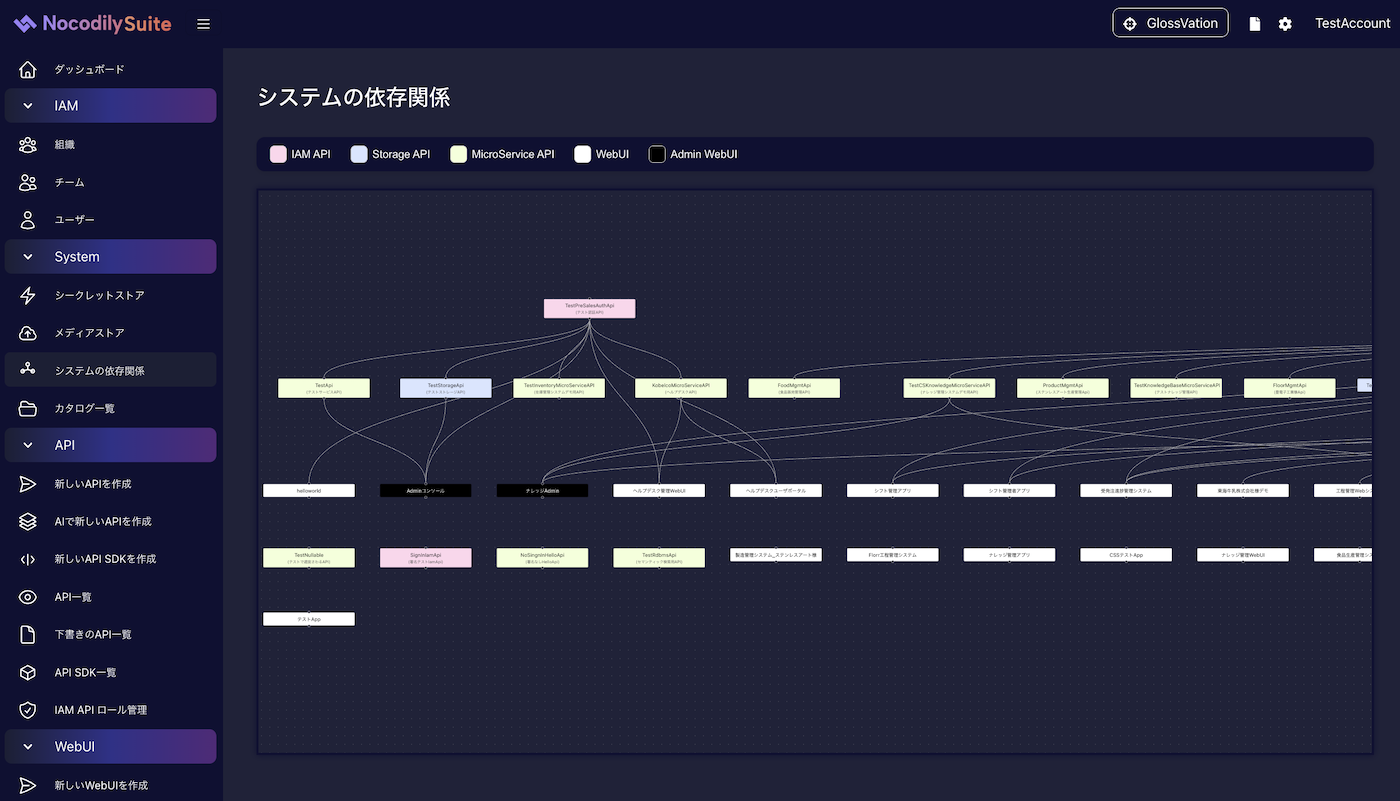
The NocodilySuite console lets you view the connections between your built APIs and WebUIs as a graph.
| What you can see | When it helps |
|---|---|
| Which MicroService APIs connect to which IAM APIs | Before changing an IAM API, assess the scope of impact |
| Which WebUIs connect to which APIs | Before upgrading an API, investigate what will be affected |
| A list of all clients connected to a given API | Audit access control and review permissions |
| The full picture of cross-team connections | Understand dependency structure across the organization |
Dependency Visibility Supports a Foundation That Keeps Evolving
Even as the number of APIs grows, dependency visibility means you can
understand the scope of a change in advance, then safely continue iterating and expanding.
Dependency visualization is not just a diagram to glance at —
it is an operational foundation for keeping the system healthy and evolving over the long term.