Company Profile
Construction / rentalEquipment center / 4 locations
Challenge Summary
The rental ledger was in Excel, and inspections were managed on a whiteboard. Calls asking "where's that equipment?" came in every day, and there was also a risk of breakdowns and accidents from missed inspections.
Key Outcomes
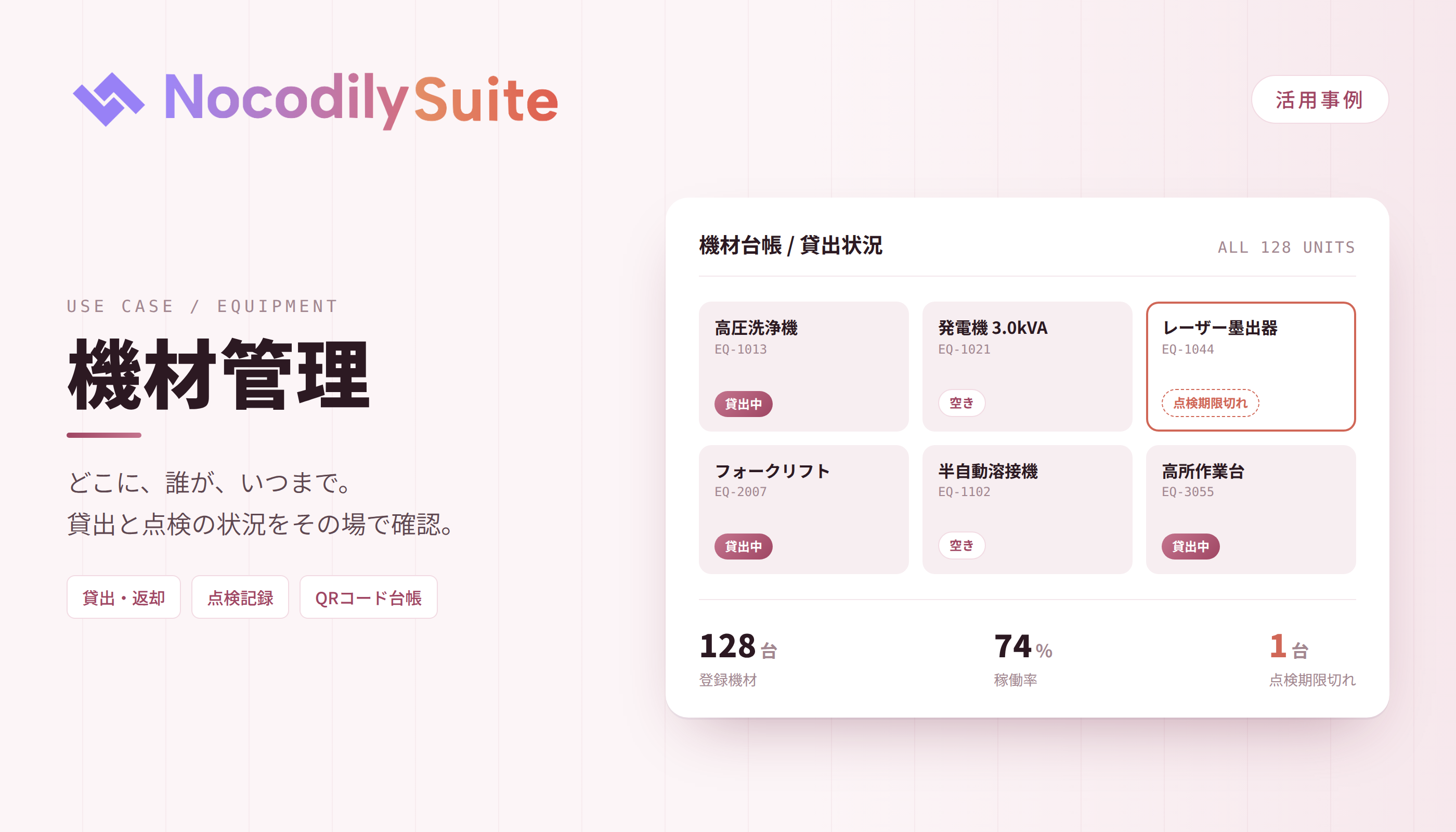
- 128 unitsRegistered equipment
- 74%Utilization rate
- −80%"Where is it?" calls
Before
Rental ledger in Excel, inspections on a whiteboard. Every "where is it now?" question generated a phone call.
After
Ledger with QR codes and rental history. Status can be checked from a smartphone on site.
Situation before deployment
The four equipment centers managed a total of 128 pieces of construction equipment and tools. The rental ledger was managed in per-site Excel files, and the inspection schedule was handwritten on a whiteboard at the back of the center.
The center received more than ten calls a day from the field asking "where's that equipment?" Staff responded by opening Excel to check or contacting other sites. Just handling these calls consumed several hours per day.
Inspections were performed based on staff checking scheduled dates on the whiteboard, and missed updates or oversights frequently occurred. There was also a risk that overdue equipment could be rented out to sites, and action was needed before an accident occurred.
Background and selection reasons
Three options were considered: a dedicated rental-industry package, a generic asset management SaaS, and building on NocodilySuite. The dedicated package was expensive to customize to our rental flow and inspection rules, and the generic SaaS had weak QR code integration and field-facing screens.
We chose NocodilySuite because features such as an equipment ledger, rental history, inspection records, and QR code issuance could be built in a short time, and it could support data sharing across four sites and smartphone use in the field. We also valued the flexibility to layer our own rules on top of the platform.
The PoC period was one month. We limited operations to 20 pieces of equipment at one site and confirmed usability with both center staff and site supervisors.
Deployment process
The overall project ran for three months. Month one was PoC and equipment master data preparation, month two was building rental, return, and inspection record features, and month three was issuing QR code labels and rolling out to four sites.
To consolidate existing Excel ledgers, we standardized the item code system across the four sites. During the transition period, both old and new codes could be searched, minimizing confusion in the field.
QR code labels were affixed to all 128 units, and when a field worker scans one with their phone, rental history, inspection status, and next scheduled inspection are displayed. Scheduled inspections were designed to notify staff via automatic reminders.
Changes after deployment
"Where is it now?" calls to the center were reduced by 80%. Since field staff can check status directly on their phones, decisions on whether equipment is available can now be made in the field.
Equipment utilization improved to 74%. Previously, some equipment was unavailable because its location was unknown; with real-time visibility, decisions to borrow from other sites are also easier to make.
Automatic inspection reminders have drastically reduced the risk of overdue equipment being rented to sites. Since deployment, overdue inspections have been kept to one or fewer at any time, contributing to accident prevention and longer equipment lifespan.
Impact (metrics)
Voices from the Team
Calls from the field asking "where's that equipment?" have stopped. Center-side response effort has dropped significantly, and we can dedicate time to our core inspection and maintenance work.— Equipment Center Manager
I can check rental status on my phone, so there are no more wasted trips. Scanning a QR code brings up the history immediately, so inspection decisions are also faster.— Site Supervisor
Future Plans
In the next phase we plan to integrate with IoT sensors for automatic run-time measurement and to expand automatic reminders for scheduled inspections. Our approach is to visualize the full lifecycle of each piece of equipment.
System CompositionEquipment management + checkout/return + inspection records + QR code ledger