Company Profile
Services / multi-storeRestaurant chain / 45 stores
Challenge Summary
Each store managed shifts with different tools, and the head office spent more than five days each month on manual aggregation. Collecting shift preferences and reflecting them also depended on individual store managers.
Key Outcomes
- 5 days → half a dayHead office monthly aggregation
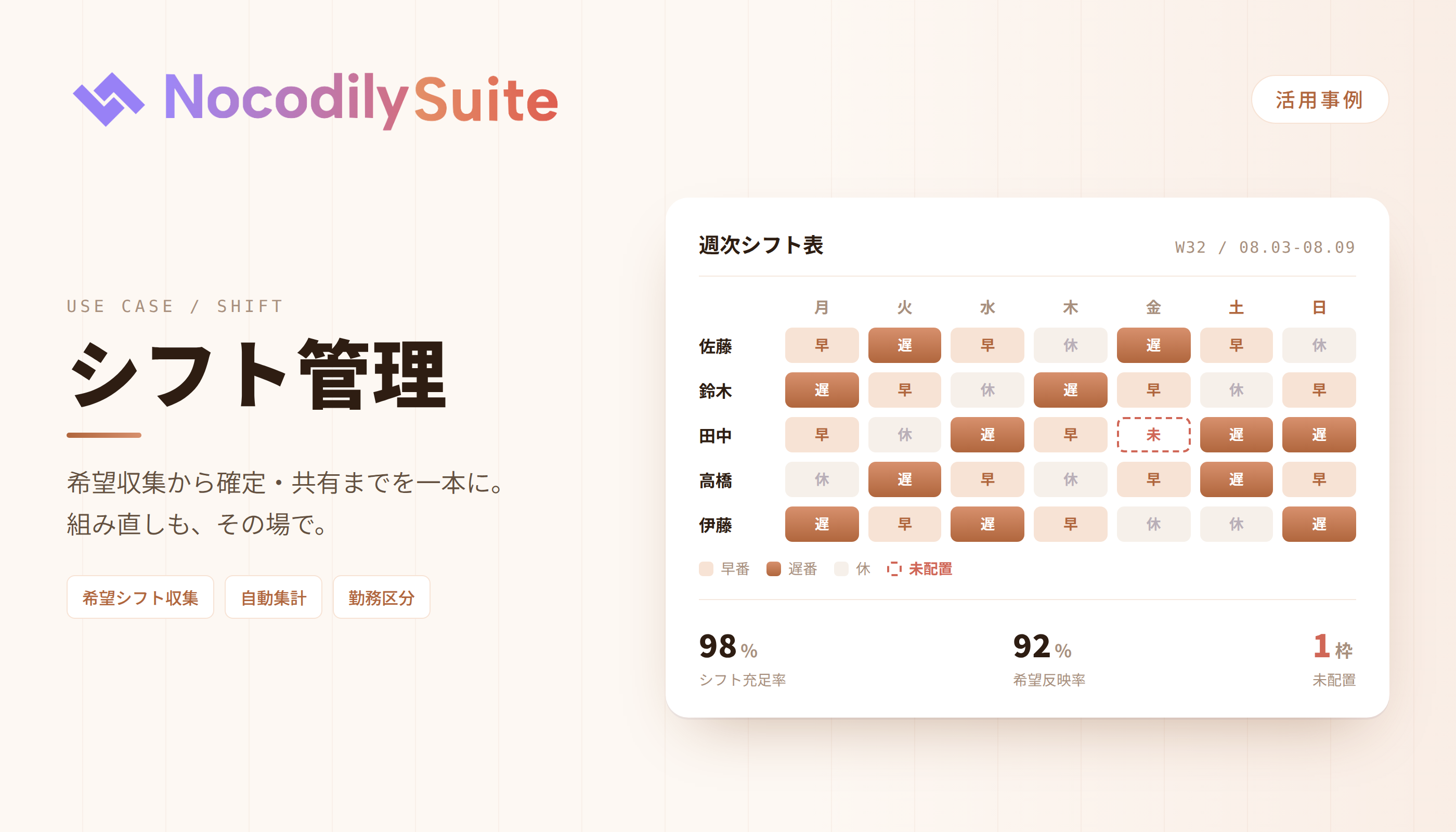
- 98%Shift fill rate
- 92%Preference reflection rate
Before
Different tools at each store, with manual aggregation at head office every month.
After
Shifts, attendance, and sales are managed on a unified platform. The head office can check status immediately via dashboard.
Situation before deployment
1,200 employees including part-timers worked across 45 stores. Shift management was done by each store manager individually in Excel or on paper, with operational rules and formats varying from store to store.
The head office Operations department collected shifts from all 45 stores at month-end for aggregation, which took more than five days each month. Overtime during the aggregation period became the norm, and the handoff to payroll processing was always cutting it close.
Preferred shifts were collected by store managers via LINE or email in an individual-dependent process, and confirmed shifts were shared by posting them on paper. Reshuffling for sudden absences was done in the store manager's head, and moving staff between stores was hampered by lack of information flow.
Background and selection reasons
Three options were considered: a shift management add-on for an HR SaaS, another vendor's no-code product, and building on NocodilySuite. The HR SaaS's annual cost for all stores was in the millions of yen, and the other no-code product used per-user pricing, which would be even more expensive at a scale of 1,200 people.
The deciding factors for NocodilySuite were that pricing is feature-based rather than per-user, so company-wide rollout costs were predictable, and that it could handle different work categories and break rules for each store through configuration, with the option to add custom development only where needed.
The PoC period was two months. We selected three stores to try it in a near-production form, gathered feedback from both store managers and employees, and then moved to production build-out.
Deployment process
The overall project ran for three months. Month one was spent on PoC and work category setup, month two on building shift creation, preference collection, and automatic aggregation, and month three on rolling out to 10 stores at a time until all 45 stores were live.
Work categories that differed by store were redesigned around common parent categories that also allowed store-specific child categories. This way, head office aggregation could be processed mechanically with common rules while still reflecting each store's reality.
Preferred shift collection was changed to have employees enter directly from their smartphones, and store managers could see the input status in real time. Confirmed shifts were also immediately pushed to employees' phones, eliminating paper postings.
Changes after deployment
Head office monthly aggregation time was reduced from five days to half a day. The handoff to payroll could be done with time to spare, and overtime at month-end and month-start in the Operations department became nearly zero.
The shift fill rate rose to 98%, and the preference reflection rate improved to 92%. Employees reported that their preferences were being honored more often, and shift-related turnover consultations have also decreased.
Head office and stores can now view the same dashboard, and decisions on moving staff between stores are made faster. Responses to sudden absences have also shifted to checking nearby stores' capacity on the spot and reaching out directly.
Impact (metrics)
Voices from the Team
Monthly aggregation overtime became nearly zero, and the workload at month-end and month-start dropped significantly. We can also check each store's status immediately on the dashboard.— Head Office Operations Section Chief
We can handle everything from collecting preferences to finalizing shifts on a single screen. Work that used to bounce between paper and Excel now takes less than half the time.— Store Manager
Future Plans
In the next phase we plan to integrate attendance records with the sales dashboard. By visualizing sales per labor hour by store, we aim to add more inputs for shift adjustment decisions.
System CompositionShift management + preferred shift collection + automatic aggregation + work categories