Company Profile
ManufacturingParts manufacturer / 3 plants
Challenge Summary
Process progress relied on verbal confirmation at each workstation, so delays were noticed only just before shipping. Workload imbalance was also invisible, and overtime response became chronic.
Key Outcomes
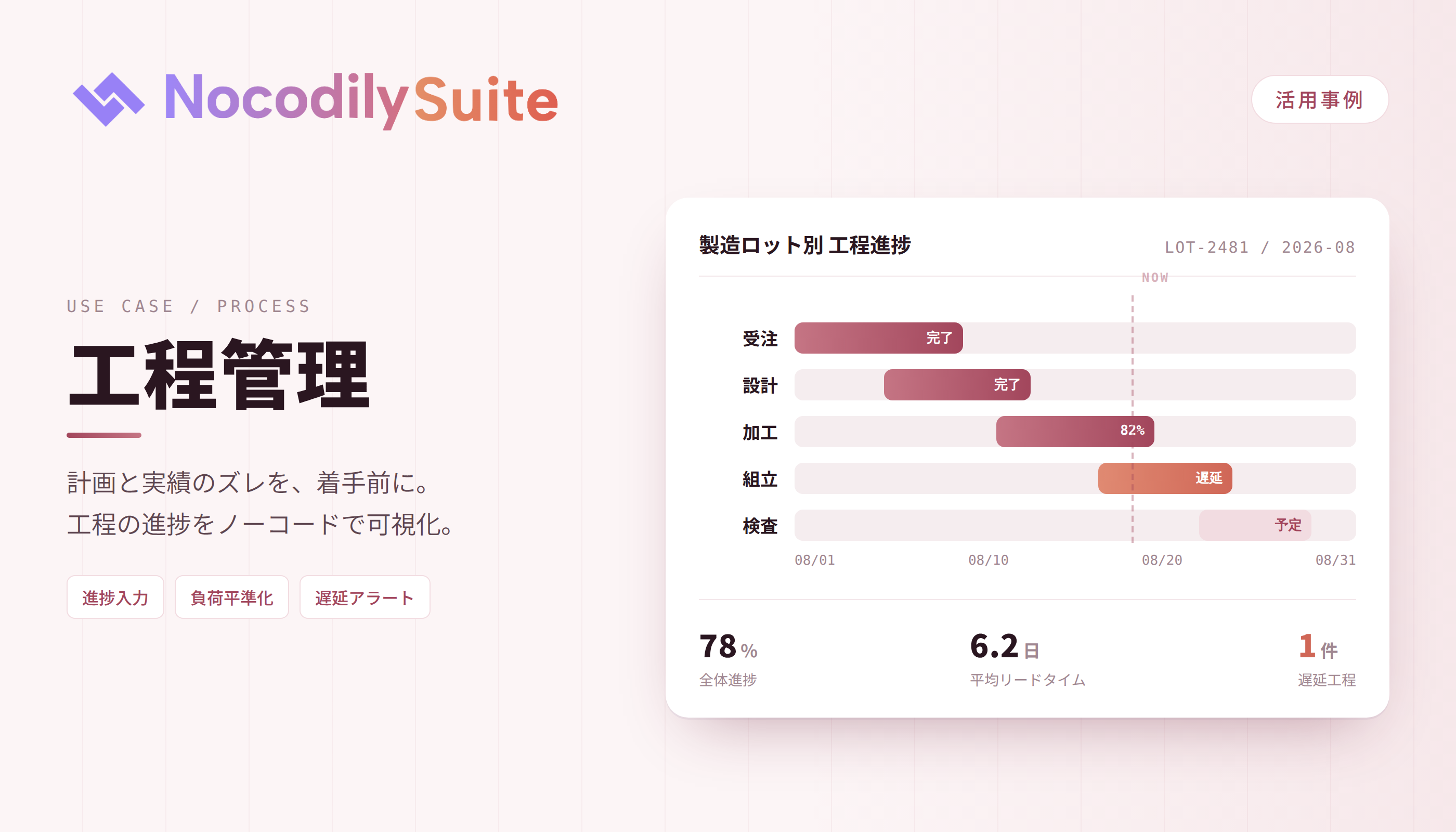
- 78%Overall progress visibility rate
- −30%Average lead time
- 6.2 daysAverage lead time
Before
Progress relied on verbal confirmation at each workstation, and delays were noticed only just before shipping.
After
Process progress is visualized by lot. Delay alerts allow response before work starts.
Situation before deployment
The three plants manufactured several hundred types of parts. The process was divided into five stages from order intake to shipping, with each workstation operating independently. Since each plant used different management tools, the Production Control department had to check overall progress by phone or email with the person in charge at each workstation.
Delays were often discovered just before shipping, and improvised responses like rushing to pull staff from other plants continued. The workload imbalance between processes was also invisible, so it was common for one process to have continuous overtime while another was idle.
Existing production control packages were often over-featured, designed for large enterprises. Either they could not be customized to fit our operations, or the customization quotes came with significant additional fees.
Background and selection reasons
Three options were considered: a major vendor's production control package, an industry-specialized SaaS, and building on NocodilySuite. The large package was expensive to customize to our processes, and there were concerns the SaaS could not absorb the operational differences across the three plants.
We chose NocodilySuite because business infrastructure such as authentication, database, and APIs was provided out of the box, giving us confidence we could assemble our unique logic—lot-based progress management and delay alerts—in a short time. We also confirmed that operational differences between plants could be handled through configuration changes.
A three-month PoC was carried out at one of the three plants. Actual production plan data was loaded in and operated by users, and after verifying usability from both the Production Control department and the shop floor, we moved to full-scale deployment.
Deployment process
The project ran for five months. The first two months were spent on PoC and process data model design, the middle two months on building the progress entry screens and delay alert functions, and the final month on the pilot at one plant and rollout to others.
Because item codes and process names differed slightly between the three plants, initial effort was spent on preparing master data. We held two inventory workshops with shop-floor staff to separate what could be standardized from what should be kept plant-specific.
Delay alerts were designed to trigger automatically when the gap between planned and actual dates exceeded two days. Notifications went to both the process supervisor and Production Control. To enable response before work started, the alerts also included the progress status of the preceding process.
Changes after deployment
Lot-level progress became visible in real time to the Production Control department, and delays were detected on average one week earlier. Rushed responses just before shipping decreased, and requests for support from other plants could be made in a planned manner.
Average lead time was reduced by 30% and stabilized at 6.2 days. Load leveling between processes became possible, and overall plant overtime hours were reduced by 25%.
Production Control and the plant manager could now check progress on the same screen, and situation sharing at the daily morning meeting became more concrete. Discussions shifted from being based on gut feeling to being based on numbers.
Impact (metrics)
Voices from the Team
We notice delays a week earlier, and the shop floor no longer scrambles. Decisions to send support to processes with spare capacity are also made faster.— Production Control Section Chief
Now that load leveling is visible, we can forecast overtime. Staffing adjustments can be planned in advance.— Plant Manager
Future Plans
In the next phase we plan to integrate with quality inspection data. By linking per-lot quality history with process progress, we aim to speed up early detection of defects and root-cause investigation.
System CompositionProcess control + progress entry + load leveling + delay alerts