Company Profile
ManufacturingPrecision machining manufacturer
Challenge Summary
Inventory was scattered across paper and Excel, with stocktakes taking three days or more. Reorder decisions were siloed to specific individuals, and stockouts and excess inventory occurred simultaneously.
Key Outcomes
- −40%Shop-floor data entry effort
- 3 days → half a dayStocktake duration
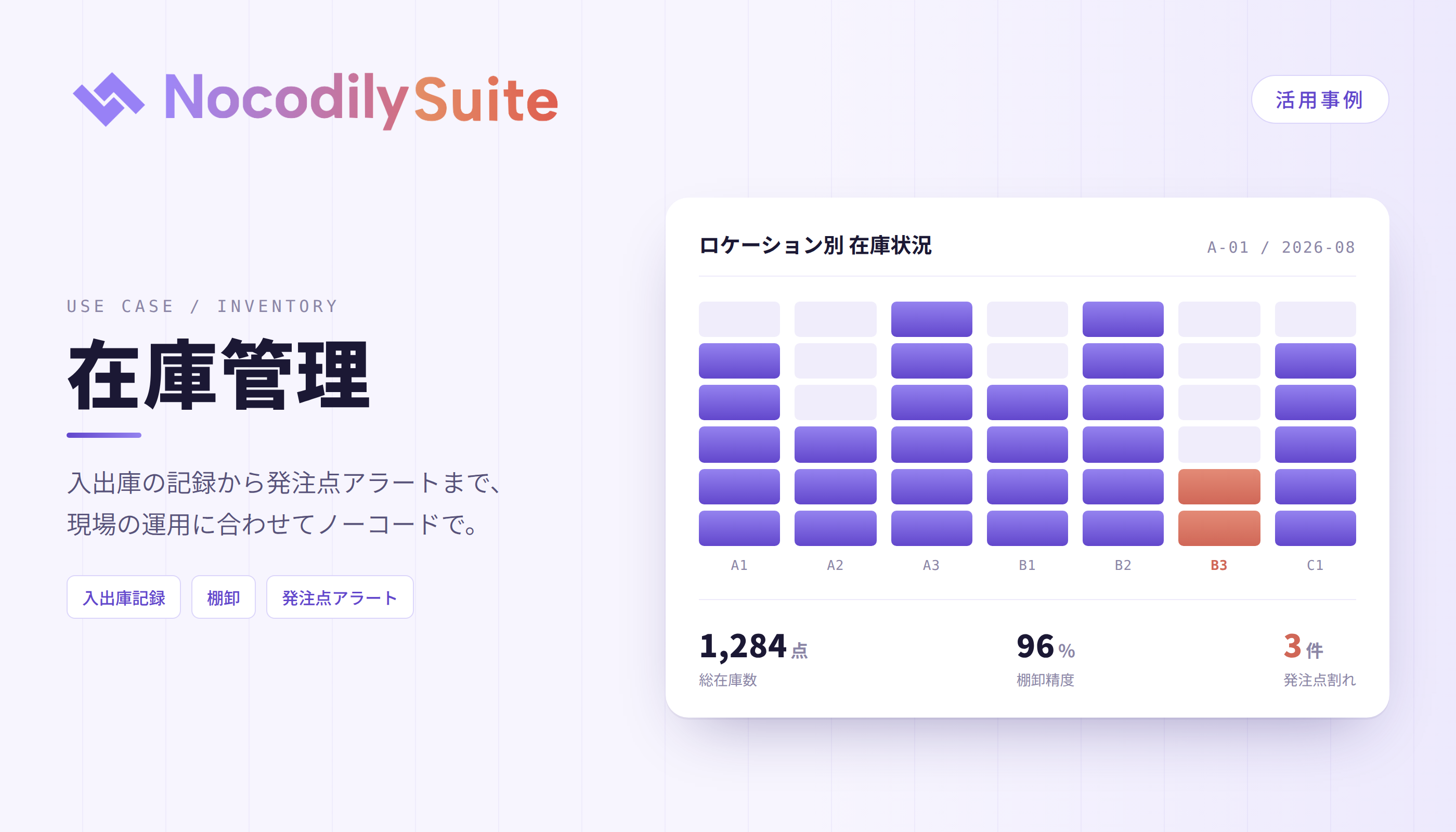
- 96%Stocktake accuracy
Before
Office staff typed paper daily reports into Excel the following day. Stocktake and process-progress aggregation could not keep up.
After
Data is entered directly from tablets on the shop floor and aggregated the same day. Reorder-point alerts are also delivered automatically.
Situation before deployment
The number of parts handled across multiple plants and warehouses reached approximately 20,000. Inventory management was operated on plant-specific Excel workbooks, with some containing hundreds of sheets. On the shop floor, workers handwrote paper daily reports, and office staff re-entered them into Excel the next day as a matter of routine.
Every stocktake required cross-checking Excel workbooks with paper records, taking more than three days each time. Numerical inconsistencies were often found mid-aggregation, and overtime for follow-up investigations became the norm.
Ordering decisions depended on the intuition of the shop-floor supervisor, and it was not unusual for stockouts and excess inventory to occur at the same time. The IT department had long considered an overhaul, but off-the-shelf packages did not fit the operational differences between plants, and full custom development was not cost-justified.
Background and selection reasons
Three options were considered: a commercial inventory management SaaS, another vendor's no-code product, and full custom development. The SaaS did not fit each plant's item code system or inspection flow, and customization quotes came with additional fees. The other no-code product used per-user pricing, raising concerns that company-wide rollout costs would grow linearly.
There were three deciding factors for choosing NocodilySuite. First, foundational elements of business systems—authentication, database, and APIs—were provided out of the box, giving us confidence we could build screens and input forms tailored to shop-floor interviews in a short time. Second, pricing is based on features used rather than user count, making budgeting predictable even at a scale of 1,000 employees company-wide. Third, we could extend only the necessary parts with custom development on top of the platform, leaving room to accommodate our unique inspection logic.
In the pre-deployment PoC, three actual shop-floor operators tried entering inventory on tablets. After confirming what could be operated without a manual, we decided to proceed with production build-out.
Deployment process
The overall project ran for four months. The first month was spent on PoC and requirements definition, months two and three on building the main screens and inbound/outbound workflows, and month four on a pilot at one plant. Rollout to the second plant was completed in the following month.
Most requests from the shop floor were detailed items such as button placement and the order of location display. Since these could be reflected in a matter of days through configuration changes on the platform side, the cycle from request to release was fast. Paper daily reports previously typed by office staff were replaced with tablet input on the shop floor, eliminating duplicate data entry.
Reorder-point alerts were designed to be triggered automatically based on inventory trends and past consumption. Ordering decisions previously made by the supervisor's intuition were replaced with a re-confirmation flow initiated by system alerts.
Changes after deployment
Stocktake duration was reduced from three days to half a day. Inventory status by location became visible in real time, and after-the-fact reconciliation work became almost unnecessary. Stocktake accuracy also improved to 96%.
Duplicate entry by office staff was eliminated, achieving a 40% monthly reduction in data-entry effort across shop floor and head office combined. A total of 180 Excel workbooks were retired. The problem of not knowing which file on the shared folder was the latest was resolved at the same time.
Since the introduction of ordering alerts, stockout incidents have decreased by 60% year over year. Disposal costs from excess inventory have also come down, and the shop floor reports no longer having to agonize over reorder timing.
Impact (metrics)
Voices from the Team
The shop floor is now self-contained with a single tablet, and rework by office staff has been eliminated. Being able to predict stocktake schedules has been a major benefit.— Information Systems Director
We no longer agonize over reorder timing. Since we can check inventory and make decisions based on alerts, accuracy stays consistent regardless of who is in charge.— Production Control Section Chief
Future Plans
The next step is API integration with the process control system. By providing a cross-cutting view of inventory and process progress, we plan to further improve the accuracy of production planning and ordering. We are also considering future integration with AI-agent-based demand forecasting.
System CompositionInventory management + inbound/outbound records + reorder-point alerts + location management