Company Profile
Internal DX / AI utilizationManufacturer / tens of thousands of internal documents
Challenge Summary
Internal documents were scattered across SharePoint, OneDrive, and email, and simply finding the required information took more than 30 minutes. There was also a risk that when a person in charge left, the procedures would be lost with them.
Key Outcomes
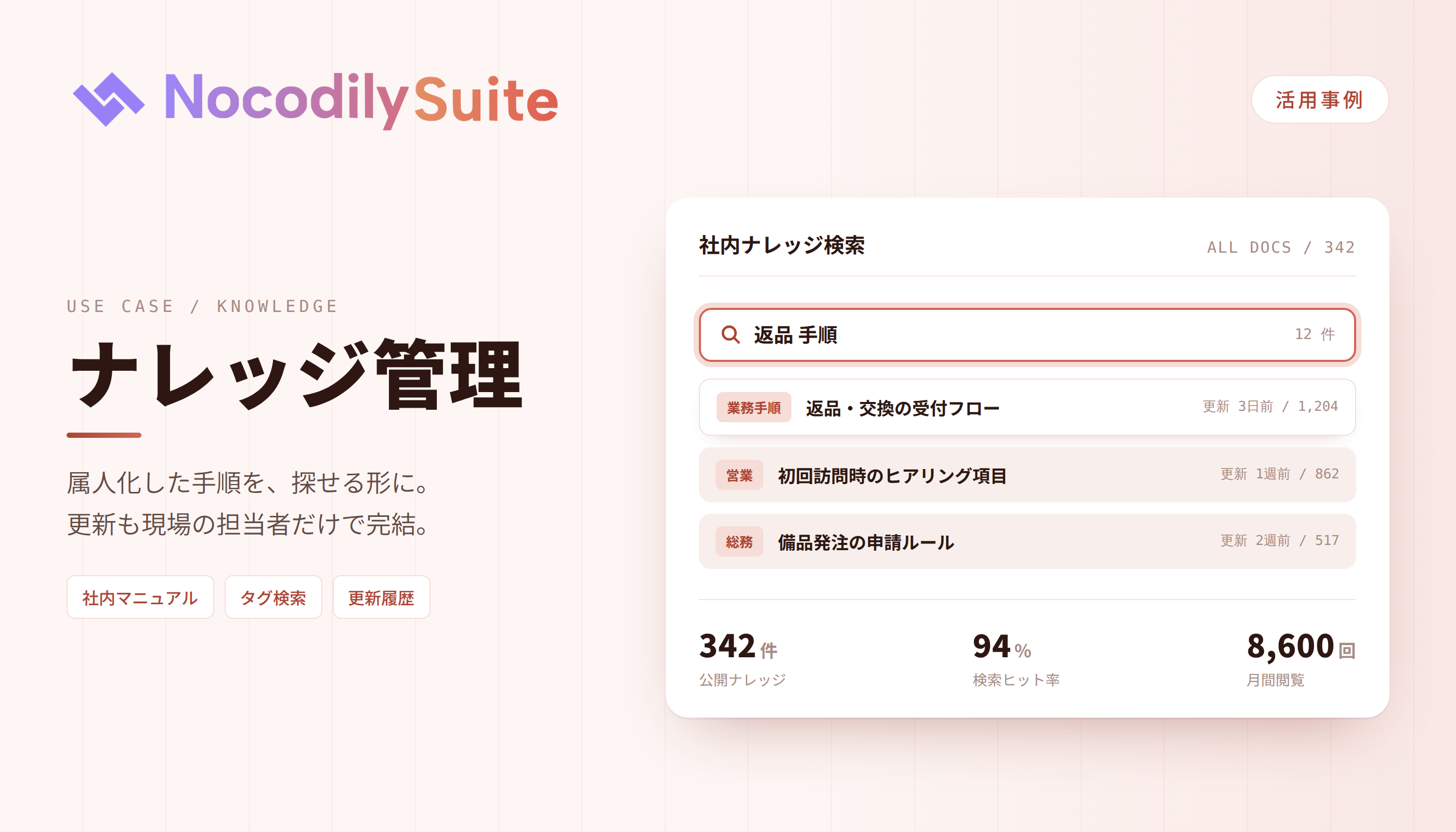
- −70%Information search time
- 94%Search hit rate
- 8,600 / monthPage views
Before
Internal documents were scattered, and finding needed information took time every time.
After
A knowledge platform with tag-based search provides instant access to needed information during work.
Situation before deployment
Internal documents handled by the 1,500 employees company-wide numbered in the tens of thousands. They were scattered across SharePoint, OneDrive, shared folders, and email, and only the person in charge knew where anything was.
New hires and staff transferring between departments spent more than 30 minutes each time looking for needed information, so they eventually just asked the "expert" directly. The burden on those experts was heavy, with a certain percentage of their work time consumed by handling questions.
When the person in charge left or transferred, the procedures and know-how in their head were repeatedly lost with them. The risk of siloed knowledge was recognized even at the executive level, but the existing information sharing platform could not fully address it.
Background and selection reasons
Three options were considered: a major vendor's knowledge management SaaS, an internal wiki product, and building on NocodilySuite. The large SaaS used per-user pricing, making company-wide rollout costly, and there were concerns that the wiki product had weak permission management and audit logs.
We chose NocodilySuite because the platform—authentication, database, APIs—was provided out of the box, with per-department permission management and revision history logging offered as standard. We also saw that we could handle unique requirements such as tag-based search and category classification in a short time.
The PoC period was two months. Led by General Affairs and the Information Utilization team, we migrated 100 actual internal manuals to verify searchability and update flow.
Deployment process
The overall project ran for six months. The first two months were spent on PoC and tag taxonomy design, the middle two on building search, update, and permission features, and the final two on migrating existing documents and rolling out to 20 departments.
For migration, we first asked each department to select their "top 20 most-referenced items" and prioritized registering them into the knowledge platform. Rather than migrating everything, we proceeded in phases starting with the most-used items, reducing the burden on the front line.
The tag taxonomy was organized around three axes: "business type," "target department," and "target system." By allowing both company-wide common tags and department-specific tags, we struck a balance between searchability and flexibility.
Changes after deployment
Information search time was reduced by an average of 70%. Monthly views reached 8,600, making it a tool used daily across the company. The search hit rate is 94%, so most searches successfully reach the needed information.
With update rights pushed down to front-line staff, information stays fresh. The number of knowledge items grew from 100 at launch to 342 within half a year, and cross-department references are also increasing.
Individual inquiries to "the expert" have decreased, helping to resolve the siloing of work. New-hire onboarding periods have also been shortened, and training cost reductions are starting to show.
Impact (metrics)
Voices from the Team
With less time spent searching, we have more time to handle other work. Points where new hires get stuck can often be resolved with past answers.— Information Utilization Lead
Now that update rights have been pushed down to the front line, we can always access the latest information. Procedures carry over even when the person in charge changes.— General Affairs Manager
Future Plans
In the next phase we plan to implement natural-language search by integrating with AI chat. We aim to further improve reuse of past answers and onboarding of new hires.
System CompositionKnowledge management + internal manuals + tag-based search + revision history