Company Profile
Information infrastructure servicesBtoB SaaS operations / SRE team
Challenge Summary
Planned maintenance announcements relied on manual work, and website postings and email sending drifted out of sync. Fallback-mode notifications during incidents also tended to lag, and SLA-related inquiries from contracted customers were rising.
Key Outcomes
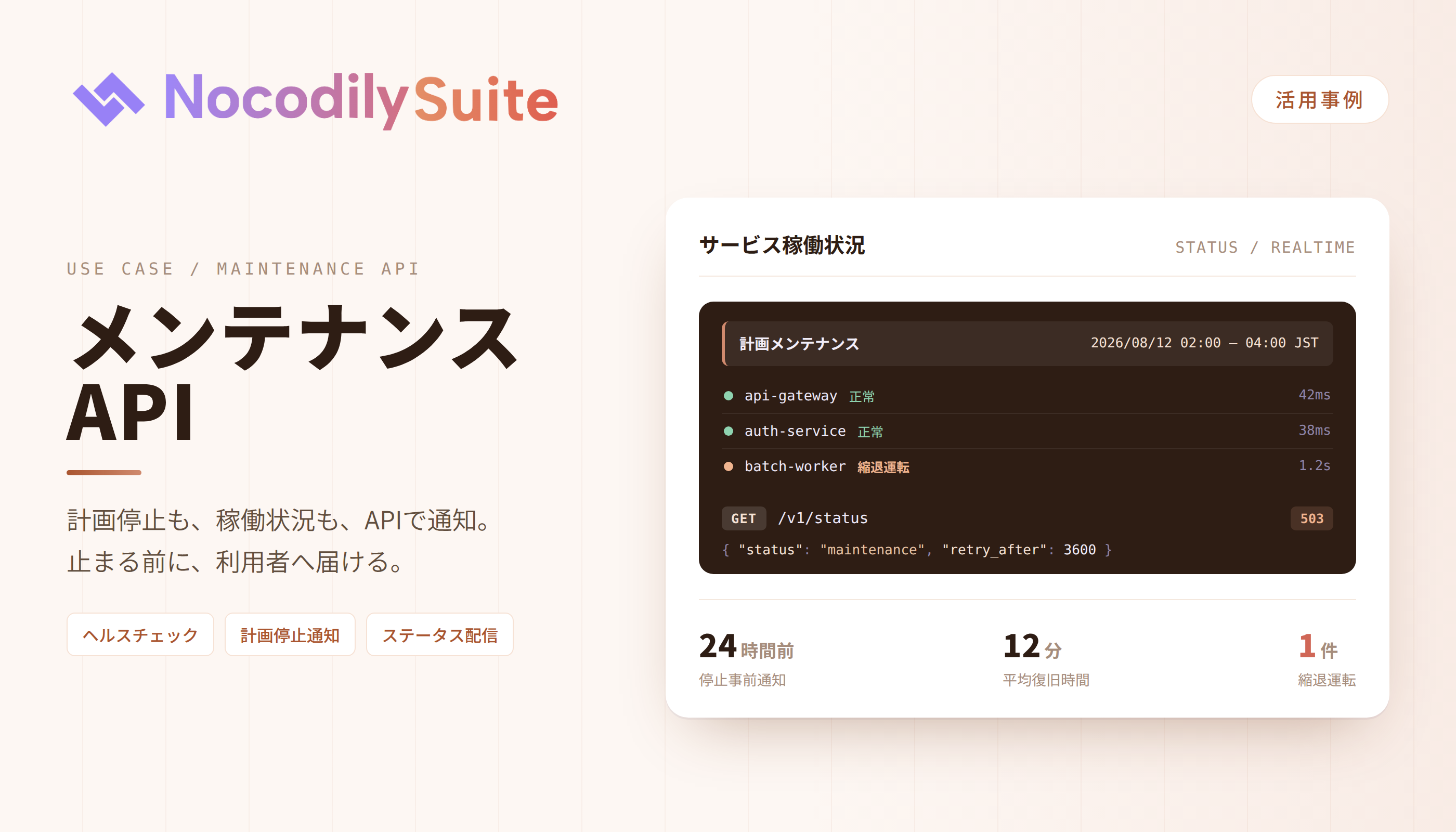
- 24 hours aheadAdvance outage notice
- 12 minAverage recovery time
- 99.95%SLA achievement
Before
Outage announcements are updated manually on the web and by email. Fallback-mode notifications during incidents lag behind.
After
Planned outages, live status, and fallback operations are delivered uniformly via APIs. All channels update simultaneously.
Situation before deployment
We operate eight data delivery services for BtoB customers. Contracted customers focus heavily on SLAs, and the frequency and timing of advance outage notices and incident-time status updates are defined at the contract level.
Outage announcements span four channels—website, notification email, API documentation posting, and messages from the sales team—each handled by different staff, so reflection timing drifted. Situations where only the email went out while the web posting lagged occurred routinely.
During incidents, deciding on fallback mode and announcing it was all manual, and the lead time from decision to announcement sometimes stretched to tens of minutes, occasionally causing secondary problems on the customer side. SLA-related inquiries reached dozens per month, driving up response effort.
Background and selection reasons
We also compared overseas status page SaaS offerings, but Japanese customization, hosting on our own domain, and integration with our existing sales system required additional development, pushing total cost above what we could accept.
We chose NocodilySuite because a single platform could build the maintenance information admin screen, API delivery, and monitoring integrations together. Combined with existing health-check monitoring, we saw a path to minimize delay from decision to delivery.
The PoC focused on one service and validated the flow from registering planned maintenance information to delivery on all four channels. After confirming the flow was operationally viable, we moved to rollout across all eight services.
Deployment process
The project ran for three months. Month one covered PoC and information model design, month two implemented the Maintenance API and status delivery, and month three rolled out to eight services and transitioned operations. On-call procedures were established at the same time.
Planned maintenance, once registered in the admin screen, is automatically delivered to web, email, API documentation, and sales-team notifications 24 hours ahead, 1 hour ahead, at start, and at end. Staff draft the message once, and delivery from there is automatic.
Status delivery during incidents is triggered by monitoring alerts; SRE just clicks the decision button to fire the fallback-mode announcement. From decision to delivery takes only a few minutes, and no notifications are missed.
Changes after deployment
Advance outage notices reliably going out 24 hours ahead is now the norm. Simultaneous delivery across four channels was achieved, eliminating inter-channel information mismatches.
Fallback-mode announcements during incidents now go out within minutes of the decision, reducing secondary problems on the customer side. Average recovery time also shortened to 12 minutes.
SLA-related inquiries dropped 70% year over year. First-response effort on the customer support side went down, letting them focus on inquiries that require substantive replies. During audits, notification history can be pulled from the API as evidence.
Impact (metrics)
Voices from the Team
Missed and delayed announcements are gone, and first-response effort for SLA inquiries dropped significantly. On-call staff can focus on status delivery.— SRE Team Lead
We can now trace which channel got the maintenance notice and when. Aligning on facts with customers has gotten much easier.— Customer Support Manager
Future Plans
In the next stage we plan automated generation of customer-facing status pages and personalized delivery scoped by impact. We will move to a form where only the notifications relevant to a customer's contracted services reach them.
System CompositionMaintenance API + health check + planned outage notice + status delivery