Company Profile
Construction / facilitiesConstruction company / 40 concurrent sites
Challenge Summary
Daily reports were on paper, reports in Word, and invoices in Excel. Errors occurred with every re-entry, and month-end overtime in the accounting team was chronic.
Key Outcomes
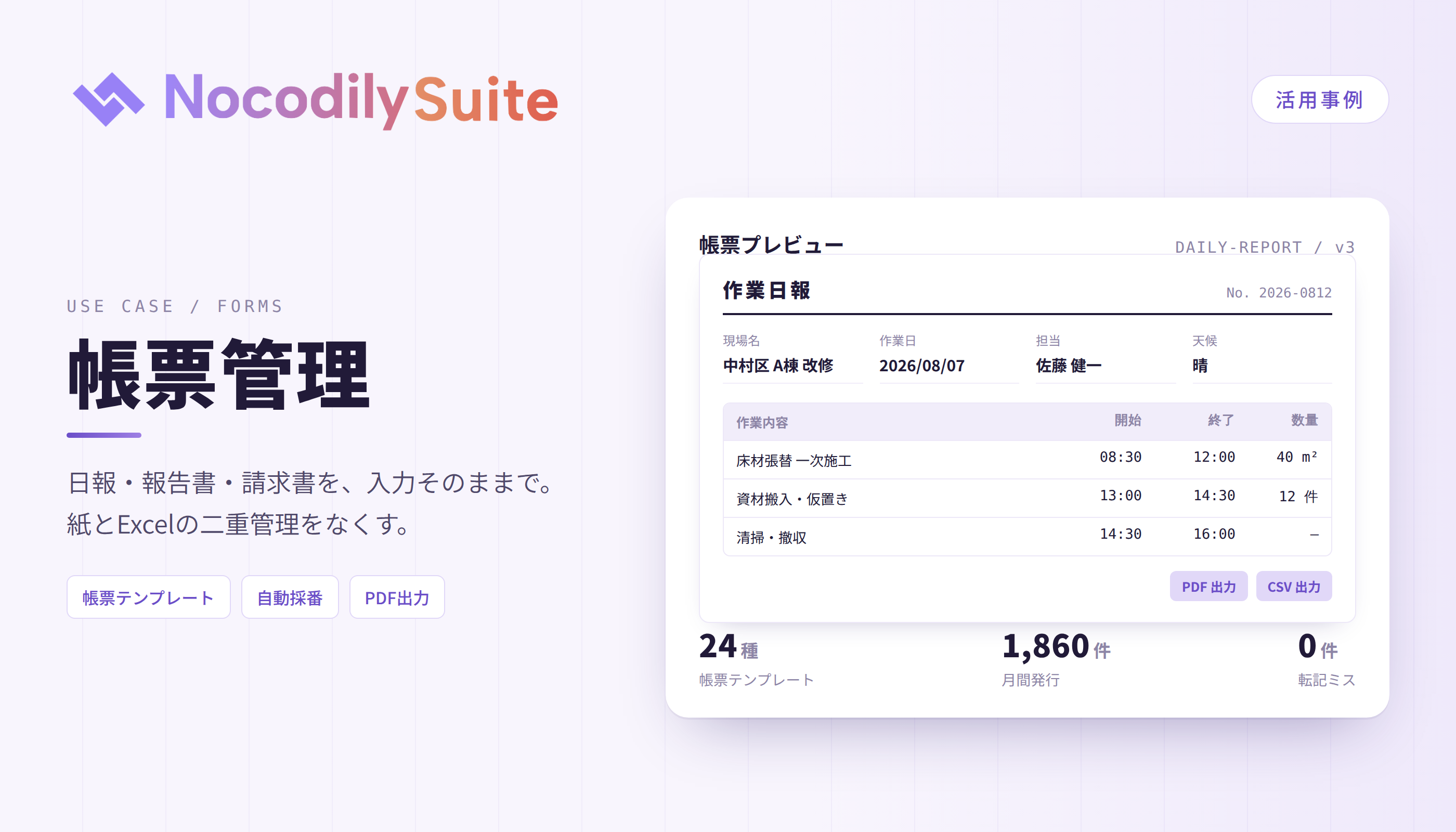
- 24 typesDocument templates
- 1,860 / monthDocuments issued
- 0Transcription errors
Before
Daily reports on paper, reports in Word, invoices in Excel. Every re-entry produced errors and waiting time.
After
Entry on site, approval, and PDF output are unified. Errors and duplicate work are nearly zero.
Situation before deployment
With 40 sites running in parallel at any given time, the company handled about 20 types of documents including daily reports, work reports, invoices, quotations, and acceptance forms. Formats varied by site and by person, and it was standard for daily reports to be on paper, reports in Word, and invoices in Excel.
Paper daily reports submitted from sites were re-entered into Excel by office staff the next day, then reflected in invoices, resulting in routine duplicate and triplicate entry. Transcription errors were frequent, and the accounting team stayed late at month-end to run consistency checks.
IT tried several times to standardize templates, but because required fields varied by site they could not be fully unified, and the practice of each person modifying their own Excel file kept returning.
Background and selection reasons
Three options were considered: a major vendor's construction-industry package, a generic document tool, and building on NocodilySuite. The construction package was expensive to customize to our document formats, and the generic tool had weak automatic numbering and approval flow features.
We chose NocodilySuite because basic features—document templates, automatic numbering, PDF output—were provided out of the box, giving us confidence we could quickly prepare a foundation that handled all 24 document types in a unified way. We also valued the flexibility to add custom fields and calculation logic on top of the platform.
The PoC period was one month. We first limited the scope to just daily reports and work reports, and after confirming usability with both site managers and accounting staff, we moved to full-scale deployment.
Deployment process
The overall project ran for three months. Month one was PoC and design of 20 document templates, month two was building automatic numbering, approval, and PDF output features, and month three was phased rollout across all 40 sites.
We analyzed existing Excel formats, separated common fields from site-specific fields, and built out a set of 14 standard templates and 10 site-customization templates. Each site could start operations simply by choosing the templates they needed.
Invoices were designed to automatically aggregate actual data from daily reports, eliminating transcription work by the accounting team. The approval flow was structured in three steps—site manager, head office department director, accounting—and could be handled from mobile as well.
Changes after deployment
Paper daily reports disappeared from sites, and office-staff duplicate entry was completely eliminated. Transcription errors are recorded as zero in the statistics. The time required to create documents was cut roughly in half, significantly reducing combined effort across site managers, office staff, and accounting.
1,860 documents can now be processed steadily each month, with no delays even when 40 sites operate simultaneously. Documents can be searched and past documents referenced, filtered by template and site.
Month-end overtime in the accounting team has nearly disappeared, and the time previously spent on chasing errors can be redirected to cost analysis and improvement proposals. As document digitization progresses, paper storage costs are also falling.
Impact (metrics)
Voices from the Team
Paper daily reports are gone, and the double-check workload has disappeared as well. It really helps that entries made on site reach the head office immediately.— Site Manager
Chasing transcription errors is over, and month-end overtime has decreased. Having invoices and daily reports connected in one system is a big win.— Accounting Director
Future Plans
In the next phase we are considering automatic attachment of site photos to documents and multi-step approval workflows. We plan to progress step by step from document digitization to fully paperless operations.
System CompositionDocument management + document templates + automatic numbering + PDF output