API-First: Building Business Systems That Adapt to Change
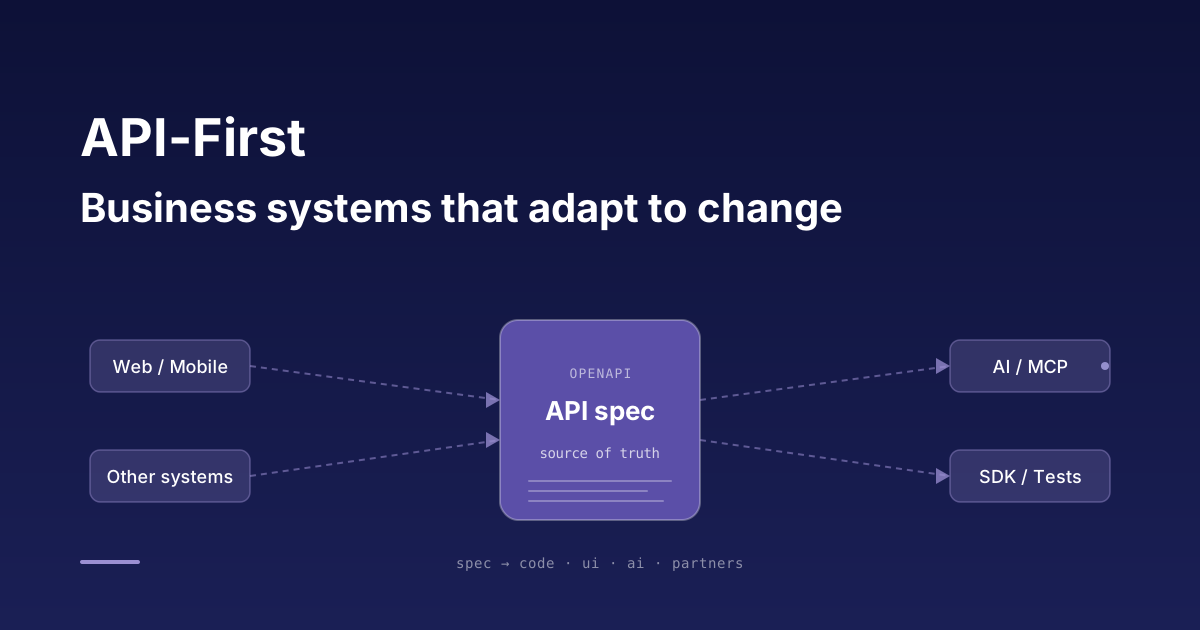
API-first design is the approach of defining your REST API specification (OpenAPI) before building any screens or clients, and treating that specification as the single source of truth for implementation, testing, and third-party integration. Long considered a technique for large-scale services, it is quickly becoming a prerequisite for ordinary business systems in the AI era.
Why API-First, Now?
Historically, business systems were built screen-first. Gather requirements, mock up screens, build the backend to match, add APIs as an afterthought if needed. This order works fine when a system is a single, self-contained app.
The demands on business systems have shifted:
- The same data is accessed concurrently by web clients, mobile, internal systems, external integrations, and AI agents
- Business processes span departments and partner companies
- Development teams are distributed and want to build UI and backend in parallel
AI amplifies all of this:
- Embedding generative AI (Claude, ChatGPT, Gemini) into internal workflows has become routine
- Standards like Model Context Protocol (MCP) give AI agents a clean way to call external systems
- RAG and data pipelines increasingly assume data is reachable through APIs
AI agents don't look at screens. Without a programmatically callable API and a machine-readable spec, AI can't touch your business systems at all. Building screen-first and adding APIs later means a large retrofit every time a new AI integration wave hits.
API-first answers this structural pressure directly. When the API contract is defined before any screen, every channel — web, mobile, external, AI — can connect to the business through the same specification.
Concrete Benefits on NocodilySuite
The general case for API-first has been well made elsewhere. Below is what you actually get when you design API-first on NocodilySuite.
These aren't nice-to-haves. They are the baseline for shipping systems with fewer bugs and higher interoperability in the same amount of time.
How API-First Comes Alive in the AI Era
Foundation models like Claude and ChatGPT don't operate a screen. They call programmatically accessible APIs and read machine-readable specs to understand what each endpoint does.
API-first's value steps up here:
- The conditions for AI are already in place: OpenAPI-compliant REST APIs, auth, permission, audit — all present if you went API-first. No AI-specific retrofit needed.
- MCP maps onto it naturally: Agent-connection standards like Model Context Protocol are mostly wrappers around existing APIs. With an API-first foundation, MCP server implementation becomes a natural derivative of the spec.
- Governance flows through: User-side access and AI-side access share the same permission system and audit log. No parallel security stack.
- Automation scope expands: Features that live only in screens cap how far you can automate. If every feature is API-callable, every business process becomes a candidate for AI integration.
Systems built screen-first hit a different wall at AI integration time: "no API, no spec, and permissions baked into the UI with no way to reproduce them outside." That wall is often too heavy to clear inside a single integration project.
Lowering API-First Implementation Cost with No-Code
Knowing API-first is valuable is not the same as being able to afford it. Standing up auth, service APIs, storage, OpenAPI spec, SDK generation, and permission design by hand is a heavy investment for a small team. Below is a rough comparison of ground-up implementation versus NocodilySuite.
Full-scratch vs NocodilySuite effort comparison
| Function / step | Full-scratch (estimate) | NocodilySuite |
|---|---|---|
| Auth infrastructure (JWT / OAuth2 / SSO / RBAC) | 2–3 person-months + ongoing | Built in, no-code configurable |
| Service API (schema → REST API) | Implement / test / deploy for every schema change | Auto-generated from definition changes |
| Storage API (signed URLs, permission control) | 1–2 person-months, S3 integration | Standard feature |
| OpenAPI spec | Hand-maintained, prone to drift | Auto-generated from definition, always in sync |
| SDK generation | Tooling setup + CI/CD pipeline | Standard feature |
| Permission / role design (RBAC / org scope) | ~2 person-months design + implementation | No-code configuration |
| Admin UI (CRUD + authorization + audit) | 2–3 person-months | Standard feature |
| Dedicated environments / tenant isolation | ~1–2 person-months infra design | Automatic per customer |
| OpenAPI-based AI / MCP integration | Integration layer + governance design | Direct from spec |
| Initial build total | ~10–15 person-months | Days to weeks |
| Ongoing cost | Continuous auth / permission / audit / schema upkeep | Absorbed by the platform |
The numbers are rough, but the structural point matters more than the absolute values. Full-scratch means you implement and maintain every piece of API-first yourself. On NocodilySuite, those pieces are the baked-in prerequisites.
NocodilySuite builds auth, service APIs, and storage APIs as a per-customer isolated environment, all configured through no-code. OpenAPI specs are auto-generated and directly callable from AI agents and MCP. You start day one with the API-first foundation already in place.
API-First Has Moved From Technique to Prerequisite
A few years ago, API-first was one modern design approach among many. Today, it is the baseline for building business systems that need to last. AI integration, cross-system connectivity, multi-client support — every demand requires that the API contract is defined up front.
When you plan a new business system, the first question is not "which product should we pick?" but "what APIs will we provide?" The design that can answer that question is the one that produces systems resilient to change.